
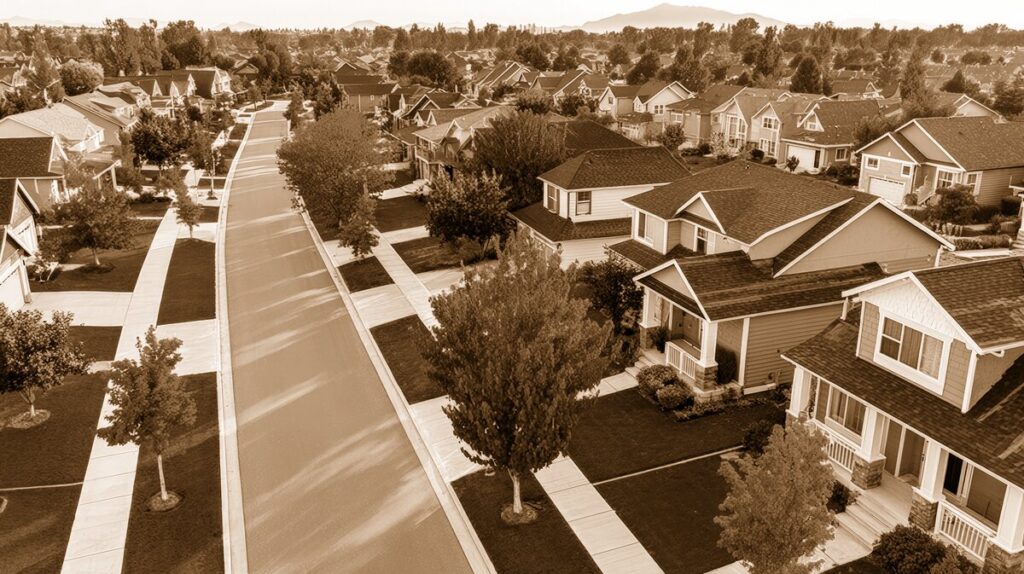
A Neighborhood with a Newer Story
Oak Ridge is one of those West Fargo neighborhoods that feels established even though much of its story is relatively recent. Located in the growing eastern-southern part of the city, Oak Ridge reflects the way West Fargo has expanded from a railroad and agricultural community into one of North Dakota’s fastest-growing suburban cities.
Today, the neighborhood is associated with residential streets, modern homes, Oak Ridge Loop East, Oak Ridge Way East, 32nd Avenue East, 33rd Avenue East, and nearby connections toward Veterans Boulevard and Sheyenne Street. Its story is not the story of one old farmhouse or a single historic building. Instead, Oak Ridge represents a newer chapter in West Fargo’s long history—a chapter built on carefully planned additions, changing land use, and the steady arrival of families, businesses, and community facilities.
From Prairie Land to City Neighborhood
Long before Oak Ridge was platted, the land around West Fargo was part of the open prairie that supported Indigenous communities, immigrant homesteaders, and agricultural families. West Fargo’s earliest recorded development followed transportation and trade.
The settlement began as a Northern Pacific Railway whistle stop near the Sheyenne River. It was first connected with the name Sheyenne Crossing and later became known as Haggart, after John E. Haggart, an early landowner and prominent Cass County figure. The railroad’s arrival in the 1870s helped establish the foundation for the community that would become West Fargo. A school followed in 1876, and railroad facilities, livestock yards, and water stations helped the area grow. ([casscountynd.gov](https://www.casscountynd.gov/Home/Components/News/News/2121/16?arch=1&cury=2015&npage=2&selectview=0&utm_source=openai))
Oak Ridge lies far from the original railroad center, but the neighborhood’s existence is directly tied to that early history. Without the transportation network, agricultural economy, and civic institutions established around old West Fargo, later residential districts would not have developed.
How Oak Ridge Got Its Name
The precise origin of the Oak Ridge name is not prominently documented in the city’s general historical materials. That is common with newer subdivisions, whose names are often chosen during the planning and platting process rather than inherited from an earlier settlement.
The name itself suggests two ideas that fit the neighborhood well. “Oak” evokes shelter, permanence, and the mature landscape residents hope a community will develop over time. “Ridge” reflects the slightly elevated, carefully graded character often associated with modern residential planning on the prairie. In a region known for broad horizons and level farmland, a name such as Oak Ridge gives a neighborhood an identity rooted in landscape and long-term growth.
City records show that Oak Ridge developed through a series of additions rather than all at once. The city’s subdivision records list Oak Ridge Second through Tenth Additions, followed by later additions, demonstrating how the neighborhood expanded in stages. ([gis.westfargond.gov](https://gis.westfargond.gov/arcgis/rest/services/Diversion/Subdivisions/MapServer/legend?utm_source=openai))
The Neighborhood Takes Shape
A major milestone in Oak Ridge’s history was the conversion of land from agricultural or undeveloped use into a planned residential area. West Fargo planning documents from the 2010s refer to Oak Ridge additions, planned-unit-development zoning, and streets such as Oak Ridge Loop East. One 2019 planning document also notes a shared path along 32nd Avenue East and the nearby Shadow Wood Park facilities. ([westfargond.gov](https://westfargond.gov/DocumentCenter/View/2290/February-Planning-and-Zoning-Commission-Agenda-Packet?utm_source=openai))
These details reveal how the neighborhood was designed as part of a broader suburban system. Streets were laid out to serve homes, but also to connect residents with parks, sidewalks, bike paths, schools, shopping, and major roads. Oak Ridge Loop East and Oak Ridge Way East provide the neighborhood with distinctive internal addresses, while nearby east-west avenues link it to the larger West Fargo street grid.
The subdivision continued to evolve through the late 2010s and early 2020s. Planning records reference Oak Ridge’s 11th, 13th, 15th, 16th, 17th, 18th, and 19th additions, illustrating the pace at which the area grew and adjusted to new housing demand. ([westfargond.gov](https://westfargond.gov/AgendaCenter/ViewFile/ArchivedAgenda/_04202020-150?utm_source=openai))
Parks, Paths, and Everyday Landmarks
Oak Ridge may not have a century-old courthouse or historic commercial block, but its landmarks are the places residents use every day.
- Oak Ridge Loop East and Oak Ridge Way East serve as recognizable neighborhood streets and help give the area its identity.
- 32nd Avenue East provides an important connection and includes a pedestrian path noted in city planning documents.
- Shadow Wood Park, located nearby, offers green space and recreation access for Oak Ridge residents.
- Veterans Boulevard connects the neighborhood with other parts of West Fargo and the expanding south-side corridor.
- Sanford Health Athletic Park and related recreation facilities are part of the broader community landscape nearby, offering athletic and wellness opportunities for residents across the area. ([mapcarta.com](https://mapcarta.com/N8078305778?utm_source=openai))
These features are important because modern neighborhood history is often experienced through routine: walking a child to a playground, taking a bike ride after supper, meeting neighbors along a path, or watching a new street become familiar as trees mature.
West Fargo’s Larger Story in the Background
Oak Ridge’s growth mirrors several major changes in West Fargo history. The city’s identity was shaped first by railroads and agriculture, then by meatpacking and industrial employment. The Equity Cooperative Packing Company began operations in 1919, and Armour and Company later purchased the plant. The packing industry remained an important part of local life until Armour closed its West Fargo plant in 1960. ([westfargond.gov](https://www.westfargond.gov/DocumentCenter/View/2569/West-Fargo-A-Brief-History-by-Petra-Leith-PDF?utm_source=openai))
West Fargo also changed politically as the community expanded. The original Village of West Fargo was incorporated in 1930, while the area south of what is now Main Avenue became the Village of Southwest Fargo in 1937. In 1967, Southwest Fargo took the name City of West Fargo, while the earlier village became West Fargo Industrial Park. Later growth and consolidation continued to shape the modern city. ([westfargofire.org](https://westfargofire.org/881/History-of-West-Fargo?utm_source=openai))
Oak Ridge belongs to this later era of development. Its homes and streets are evidence of a city that no longer depends on one industry or one central district. Instead, West Fargo now grows through a network of neighborhoods, schools, parks, businesses, and transportation corridors.
A Neighborhood Still Writing Its History
One of the appealing things about Oak Ridge is that its heritage is still being created. Older West Fargo neighborhoods carry the visible marks of early railroading, packinghouses, family farms, and mid-century construction. Oak Ridge carries the marks of a different period: planned additions, modern housing, shared paths, recreational facilities, and a community built around connection.
As the neighborhood matures, the character of Oak Ridge will increasingly come from the people who live there. Young trees will grow taller. Familiar routes will become walking traditions. New families will add their own memories to the neighborhood’s timeline, while nearby parks and streets become part of daily life.
For longtime West Fargo residents, Oak Ridge is a reminder that local history does not stop with old buildings. It continues whenever open land becomes a street, whenever neighbors gather, and whenever a new part of the city develops its own sense of belonging. Oak Ridge may be one of West Fargo’s newer neighborhoods, but it already reflects the community’s enduring spirit: practical, welcoming, family-minded, and always looking toward the future.